
Cold-water immersion reliably reduces muscle soreness and speeds perceived recovery when you follow an evidence-informed protocol. It is not a weight-loss tool, and this article treats it that way: as a recovery method for athletes, backed by the BASES expert statement and applied through the kind of tailored setups Elevate Performance Systems builds for home and facility use.
TL;DR:
- Cold-water immersion improves muscle power and reduces soreness up to 96 hours after high-intensity exercise, but does not significantly enhance strength recovery.
- The recommended protocol involves immersing waist or mid-torso in 8 to 12°C water for 8 to 12 minutes within 30 to 60 minutes after training, especially during high-frequency or competition periods.
- Equipment must maintain consistent temperature and sanitation to ensure effective recovery and safety, with automated filtration and ozone systems being ideal.
- Individuals with certain medical conditions require doctor clearance before cold plunge use, and overexposure poses risks without proven benefits for weight loss.
- Cold plunge supports training and recovery but is ineffective as a primary weight-loss method; proper timing and equipment are crucial for maximizing its benefits.
Table of Contents
- What Do Systematic Reviews Say About Cold-Water Immersion?
- How Cold Should the Water Be and How Long Should You Stay In?
- When Should You Use Cold Plunge, and When Should You Skip It?
- What Equipment Features Actually Matter for a Reliable Setup?
- Who Should Avoid Cold Plunge, and What Safety Rules Apply?
- How Do You Keep a Cold Plunge Consistent Week to Week?
- Why Do People Associate Cold Plunge With Weight Loss?
- Does Cold Plunge Work Better Than Other Weight Loss Methods?
- How Often Should You Cold Plunge If Weight Loss Is a Goal?
- What Are the Risks of Using Cold Plunge for Weight Loss?
- How Should Cold Plunge Fit Into a Broader Diet and Exercise Plan?
- A Publisher’s View on Building Recovery Around Cold Plunge
- Ready to Build Your Cold Plunge Recovery Setup?
- Sources
What Do Systematic Reviews Say About Cold-Water Immersion?
The strongest evidence on cold-water immersion (CWI) comes from a 2022 Sports Medicine systematic review and meta-analysis covering 52 randomized studies. It found CWI improved muscular power at 24 hours after eccentric and high-intensity exercise, cut serum creatine kinase (a marker of muscle damage) at 24 hours, and improved both soreness and perceived recovery. Strength recovery, though, showed no meaningful benefit. That distinction matters for how you set expectations: CWI helps you feel and move better sooner, but it doesn’t necessarily restore maximal strength any faster than passive rest.
A separate PLOS One meta-analysis backs the soreness findings out to 96 hours, using a mean study temperature near 10°C.
- Power recovery at 24 hours: moderate improvement after eccentric and high-intensity exercise
- Creatine kinase: reduced at 24 hours after high-intensity exercise
- Muscle soreness: reduced through 96 hours in the PLOS One analysis
- Strength recovery: no significant benefit found
The gap in the data: at least one placebo-controlled trial in national-level soccer players found CWI performed no better than a sham treatment for match recovery or for training adaptations over 15 weeks. Results shift with population, training status, and study design, which is why a single “CWI works” headline oversimplifies things. Treat the meta-analyses as your baseline, and treat any single study, including the null ones, as one data point inside a bigger picture.
How Cold Should the Water Be and How Long Should You Stay In?
The BASES expert statement describes the applied-sport standard most trainers reference: waist or mid-torso immersion for 8 to 12 minutes at roughly 8 to 12°C. That’s cold enough to trigger the physiological response the meta-analyses measured, without pushing into territory that adds risk for no added benefit. Shorter, colder exposures show up in some studies too. One Sports Medicine analysis noted that briefer, lower-temperature sessions sometimes correlated with larger creatine kinase and soreness improvements, though the relationship isn’t linear enough to chase extremes.
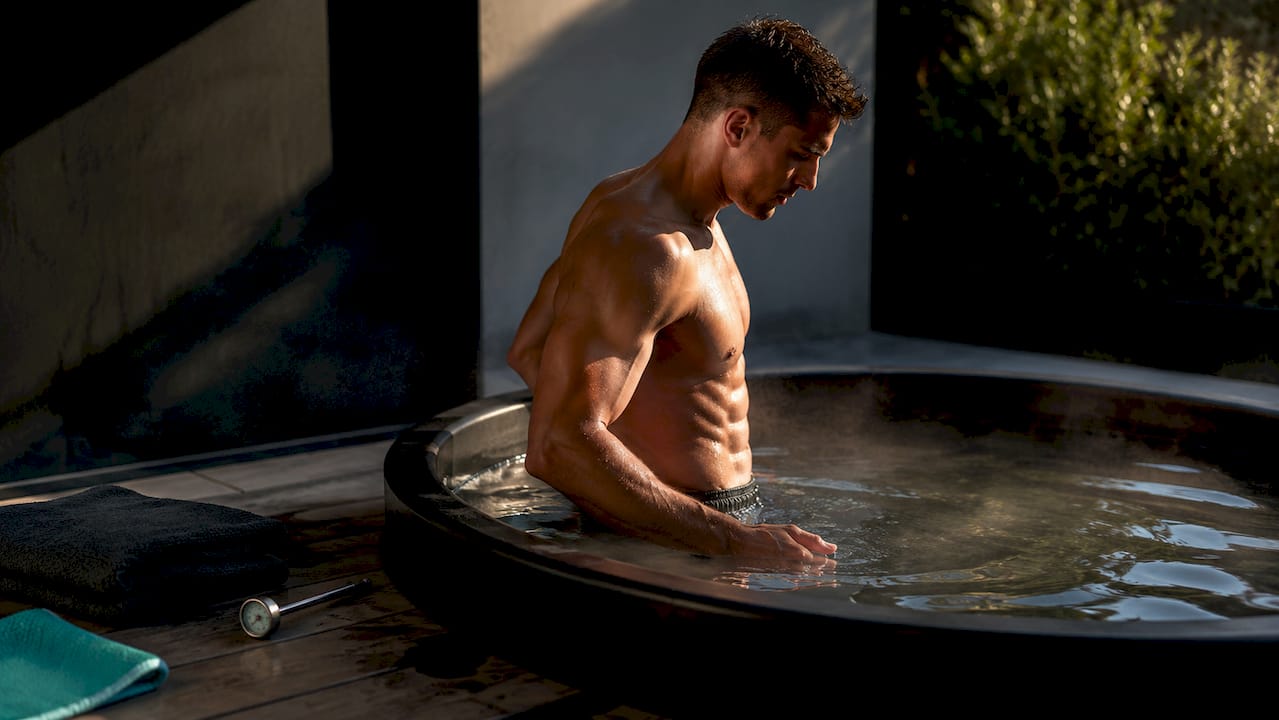
Timing depends on what’s next on your calendar. If you have a heavy training session or competition inside 24 to 48 hours, CWI right after the prior bout helps you show up fresher. If your priority is strength or hypertrophy adaptation and your next session is days away, skip the immediate post-lift plunge. Immersing right after resistance training can blunt the inflammatory signaling that drives muscle growth.
Here’s a simple checklist to run before every session:
- Confirm water temperature reads 8 to 12°C with a reliable thermometer, not a guess.
- Set a timer for 8 to 12 minutes and stay at or above the waist unless your protocol specifies otherwise.
- Immerse within roughly 30 to 60 minutes of finishing the prior training bout for best perceived-recovery results.
- Monitor how you feel. Shivering that becomes uncontrollable is your signal to exit early.
- Log the session so you can track dose against recovery outcomes over weeks, not just once.
Pro Tip: Keep a small waterproof log by the tub. Athletes who track temperature, duration, and next-day soreness tend to stick with the protocol longer because they can see it working.
When Should You Use Cold Plunge, and When Should You Skip It?
CWI earns its place in a program during periods of dense competition or repeated high-intensity work, where recovering fast matters more than maximizing long-term adaptation. It’s a strong fit for:
- Tournament weekends or multi-event days with only hours between bouts
- Training blocks stacked with back-to-back high-intensity sessions
- Travel recovery, where soreness and fatigue compound quickly
- In-season maintenance where the goal is availability, not building new strength
It’s a poor fit when the plunge would undercut the training itself:
- Immediately after resistance sessions aimed at strength or hypertrophy, since blunting inflammation can dull adaptation signals
- Daily, indefinite use across an entire off-season, where consistent inflammation-dampening may work against the gains you’re training for
- Early-phase base building, when adaptation matters more than same-week readiness
The decision rule is straightforward: ask how much time sits between now and your next heavy load. Hours away, favor CWI. Days away, and the session was about building rather than performing, favor letting the natural recovery process run. The BASES commentary frames this as a decision tree built around training phase and recovery window, not a fixed rule applied every time. For more on sequencing, see this breakdown of how often to use cold plunge across a training cycle.
What Equipment Features Actually Matter for a Reliable Setup?
The dose that shows up in the research (8 to 12 minutes at 8 to 12°C) only helps you if your equipment can hit and hold that range session after session. A cooler full of ice and a stock tub can get you there once. Keeping it there through a full training week, with multiple users, is a different problem entirely.
Practical experience across facilities points to two recurring failure points: inconsistent temperature and difficult sanitation. Athletes drift away from good protocols not because the science stopped working, but because the equipment made compliance annoying.
Minimum specs for a home athlete:
- Active temperature control that holds 8 to 12°C without daily ice runs
- A pump strong enough to keep water circulating between sessions
- A footprint that fits your space without turning setup into a chore
- Simple filtration you’ll actually maintain weekly
Facility spec checklist for gym owners:
- Insulated build rated for multiple daily immersions
- Ozone or comparable sanitation system to manage cross-user hygiene at volume
- Durable materials rated for continuous commercial use
- A monitoring display staff can check at a glance, not a hidden dial
Recovery setups should address the gap between lab protocol and daily use by matching temperature control and sanitation capacity to the number of users. The Pro Cold Plunge System is built for that consistency, and units like the 1HP Premium Cold Plunge Tub with ozone sterilization pair temperature stability with lower-maintenance sanitation.
Pro Tip: If sanitation feels like a hassle, you’ll skip it. Choose a system with ozone or automated filtration before you choose one on price alone. It’s the difference between a tub you use consistently and one that becomes storage.
Who Should Avoid Cold Plunge, and What Safety Rules Apply?
Some people need medical clearance before starting cold-water immersion, and some conditions rule it out entirely without a doctor’s input. Cardiac disease, uncontrolled hypertension, Raynaud’s phenomenon, and a history of seizures all warrant a conversation with a physician before stepping in.
Operational safety matters just as much as who’s allowed in the water. A position statement on cold-water immersion safety lays out the core rules facilities and home users should both follow:
- Keep your head above water at all times; never submerge fully
- Supervise first-time users until you know how they respond to cold exposure
- Verify temperature with a calibrated thermometer, not touch or guesswork
- Post clear signage on maximum duration and temperature range
- Acclimatize gradually. Don’t jump straight to 8°C on day one
Facilities should add a screening intake, a written emergency response plan, and staff trained to recognize signs of distress before opening a plunge to members.
How Do You Keep a Cold Plunge Consistent Week to Week?
A cold plunge only delivers the recovery benefits from the research if it actually holds its target temperature and stays clean enough that people want to use it. That comes down to a maintenance rhythm, not a one-time setup.
- Daily: check the temperature display, skim the surface, and confirm the pump is circulating.
- Weekly: test water quality, clean or rinse filters, and check ozone output if your unit uses it.
- Monthly: deep-clean the tub, inspect seals and hoses, and verify your thermometer against a second reading.
Skipping any of these steps is exactly how temperature drift and hygiene problems creep in, and it’s usually the reason athletes quietly stop using a plunge that once worked fine. A detailed cold plunge maintenance guide covers product-specific steps, and this look at ozone sanitation trade-offs is worth reading before you decide between filtration approaches.
Why Do People Associate Cold Plunge With Weight Loss?
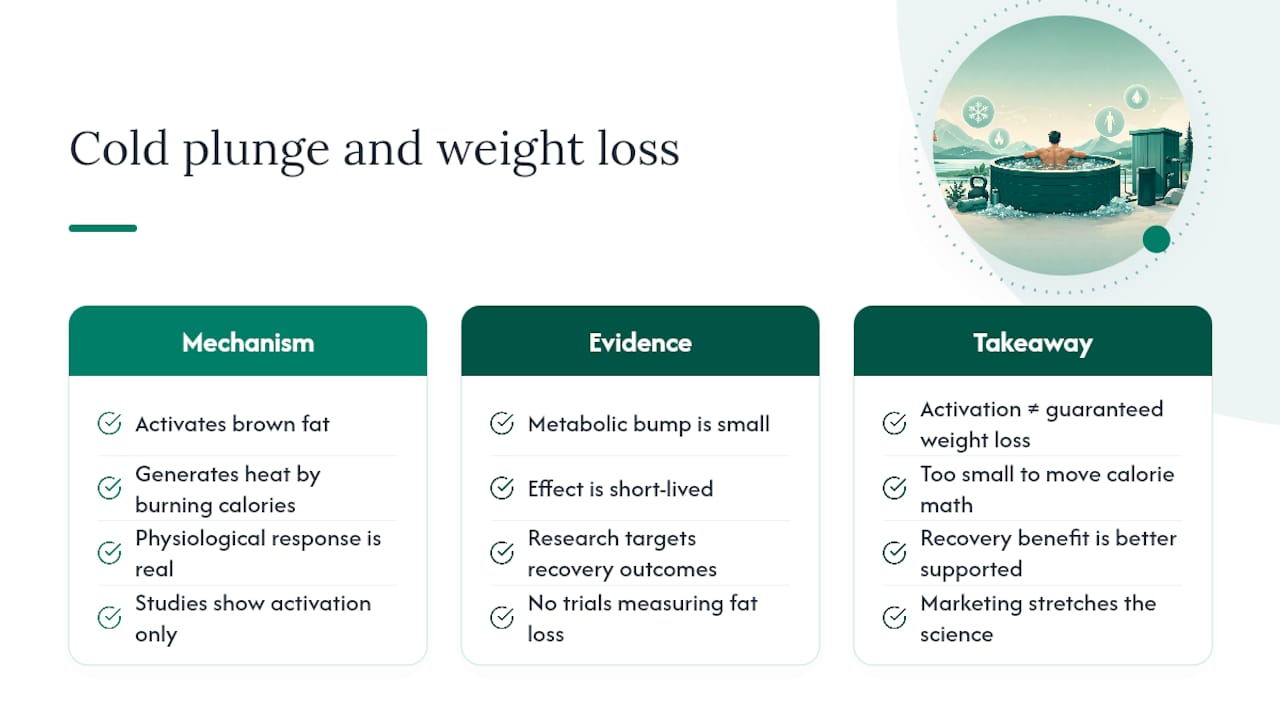
The theory behind cold exposure and weight loss centers on brown fat, a tissue that generates heat by burning calories rather than storing them the way white fat does. Cold exposure can activate brown fat and modestly raise metabolic rate as your body works to maintain core temperature. That’s a real physiological response, and it’s the basis for most of the popular claims connecting cold plunges to fat loss.
Where the claims outrun the evidence is scale. The metabolic bump from a single cold-water session is short-lived and small relative to the calorie math involved in meaningful weight change. The research reviewed here, including the Sports Medicine meta-analysis and the BASES expert statement, was built around recovery outcomes: power, soreness, and perceived readiness, not body composition. None of it measured cold plunge as a fat-loss intervention, and extrapolating recovery data into weight-loss promises stretches the findings past what they actually show.
If you’re shopping for a cold plunge with weight loss as the goal, it helps to separate the mechanism from the marketing. Brown fat activation is real. Whether a few minutes of cold water several times a week moves the needle on your weight is a different question than whether it helps you recover faster between hard training sessions, which is where the evidence is actually strong.
Does Cold Plunge Work Better Than Other Weight Loss Methods?
Compared with the two levers that reliably drive weight change, a calorie deficit through diet and consistent exercise, cold plunge sits in a supporting role at best. Diet and exercise interventions have decades of controlled research behind their weight-loss effects. Cold-water immersion has none of that same body of evidence backing it as a primary method.
The limitation isn’t that cold exposure does nothing. It’s that its measurable effects (mild, temporary increases in energy expenditure) are small next to the deficit created by structured eating changes or added training volume. Athletes and trainers considering a cold plunge for this purpose should treat it as a minor complement, not a substitute for the fundamentals.
Where cold plunge does hold a genuine advantage over other methods is recovery, not weight. Faster perceived recovery and reduced soreness mean you can train harder and more often, which indirectly supports any weight-management goal you’re chasing through activity. The plunge isn’t burning the calories. The training you’re able to sustain because you recovered well is doing that work.
If body composition is the primary goal, a coach or dietitian designing your nutrition and training plan will do more for you than any tub temperature. Cold plunge earns its spot alongside that plan, not ahead of it.
How Often Should You Cold Plunge If Weight Loss Is a Goal?
There’s no established frequency specifically tied to weight-loss outcomes from cold plunge, because the research base doesn’t support treating it as a weight-loss protocol in the first place. What does have support is the recovery-focused frequency guidance from the sports-science literature.
For recovery purposes, most protocols call for sessions after high-intensity training days or competition, using the 8 to 12 minute, 8 to 12°C dose described earlier. If you’re layering cold exposure into your week hoping for a secondary metabolic benefit, aligning it with your existing recovery schedule (rather than adding extra sessions purely chasing a fat-loss effect) keeps the practice sustainable and evidence-grounded.
Adding more sessions than your recovery needs actually call for doesn’t strengthen a weight-loss case; it just adds cold-water exposure without a matching physiological rationale. A detailed frequency guide breaks down how session count should track your training calendar, which is the more reliable framework than chasing an unproven weight-loss cadence.
What Are the Risks of Using Cold Plunge for Weight Loss?
The same safety rules that apply to recovery-focused cold plunge apply here, and they carry the same weight regardless of your reason for stepping in. Cardiac conditions, uncontrolled hypertension, Raynaud’s phenomenon, and seizure history all require medical clearance before cold-water immersion, whether your goal is recovery or something else.
Beyond the medical contraindications, a specific risk shows up when weight loss becomes the motivation: overexposure. Someone chasing a metabolic effect may be tempted to extend session length or drop temperature further than protocols recommend, on the assumption that colder or longer means more calories burned. That reasoning increases risk (cold shock, uncontrolled shivering, hypothermia) without reliable evidence that it improves outcomes.
Cold exposure also affects appetite and stress hormones in ways that vary by individual. Some people report increased hunger after cold sessions, which can undercut any calorie deficit they’re trying to maintain elsewhere. This is an argument for keeping doses within established recovery ranges rather than experimenting with intensity in pursuit of a benefit the evidence doesn’t clearly promise.
How Should Cold Plunge Fit Into a Broader Diet and Exercise Plan?
Cold plunge works best as a supporting piece next to the two factors that actually drive weight change: nutrition and training volume. Used this way, its real contribution is indirect. Better recovery means more consistent training weeks, and consistency is what produces results over months, not any single recovery method.
Practically, that means scheduling cold plunge around your hardest training days rather than treating it as an independent weight-loss lever. Pair it with a nutrition plan built around a genuine calorie deficit if weight loss is the target, and let the recovery benefit support your ability to keep training hard through that deficit, since fatigue and soreness tend to compound when you’re eating less.
Combining modalities can help here too. Compression recovery tools like the Elevate Apex Pro Recovery Boots address circulation and muscle fatigue in a way that complements cold-water immersion rather than duplicating it, giving you two levers for recovery instead of one. Athletes managing high training volume while also managing calorie intake often need every recovery advantage they can stack.
The honest takeaway: cold plunge supports the training that drives weight loss. It isn’t the mechanism doing the driving itself.
A Publisher’s View on Building Recovery Around Cold Plunge
The mistake I see most often is athletes buying a cold plunge like it’s a single-purpose weight-loss gadget, then feeling let down when the scale doesn’t move. That’s not what the evidence supports, and it’s not how Elevate Performance Systems approaches a build.
The better question is: what’s your training schedule actually asking of your body? A competitive schedule stacked with back-to-back events needs a different setup than someone training for hypertrophy three days a week. We match modality, whether that’s cold plunge alone or paired with compression boots and red light therapy, to that schedule, plus your budget and how much maintenance you’re actually willing to do.
If you want a system built around your calendar instead of a generic protocol, requesting a tailored setup gets you further than another tub review ever will.
— Derek
Ready to Build Your Cold Plunge Recovery Setup?
Some companies design recovery systems around your training calendar instead of selling one tub and hoping it fits. This approach differs from generic units that may hold temperature poorly or demand more maintenance than users maintain.
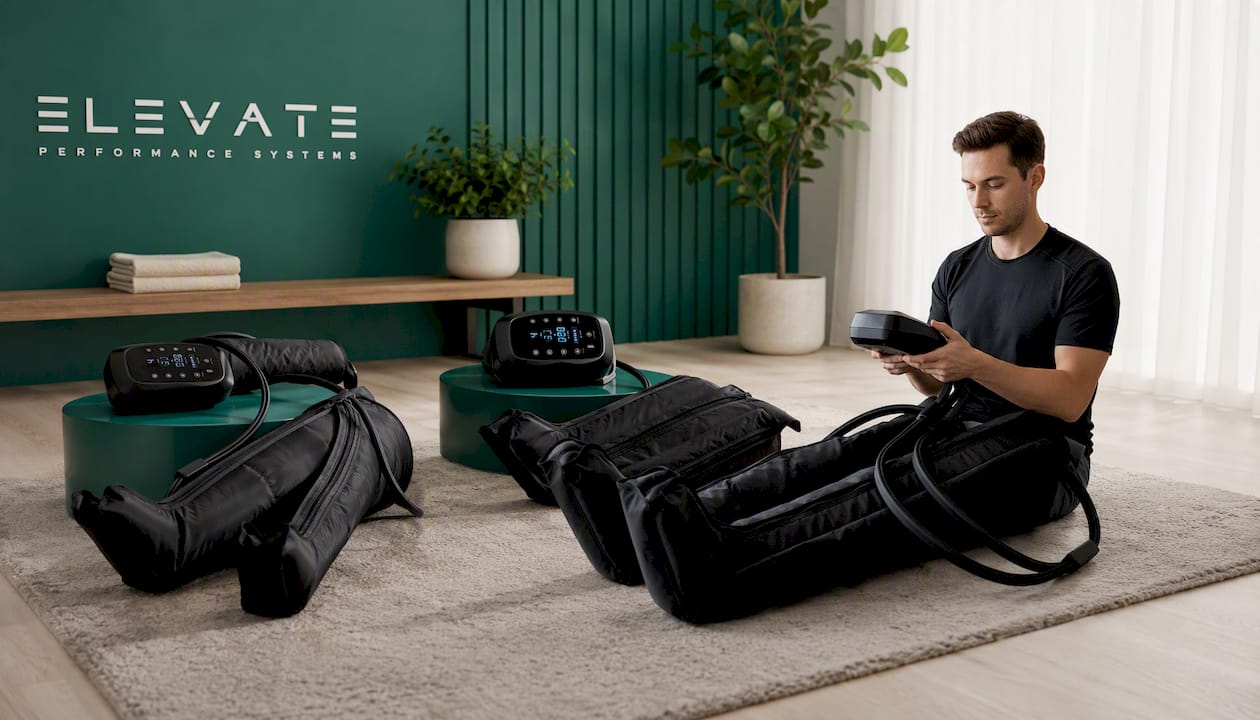
If you’re training solo at home, the Pro Cold Plunge System gives you the temperature consistency the research protocols require without daily ice runs. Trainers and small facility owners managing multiple users benefit from combining a plunge with complementary modalities. The Elevate Apex Elite Recovery Boots and Elevate Pulse Recovery Boots both pair well with cold-water immersion for athletes juggling heavy schedules. Request a consultation and we’ll match a setup to your training load, space, and budget before you spend a dollar.