
For acute muscle soreness right after hard training, cold plunge wins. For cardiovascular health and long-term relaxation, sauna wins. If you want both circulatory benefits and a tonic effect, the sauna followed by cold plunge is a well-supported combination for most healthy adults. Anyone with heart disease, arrhythmias, or uncontrolled blood pressure should get medical clearance before either.
TL;DR:
- Cold plunges are most effective for immediate soreness relief, with water typically below 59°F and sessions lasting 1 to 5 minutes.
- Saunas, especially traditional ones, are better suited for long-term cardiovascular health and stress reduction, with sessions lasting 10 to 20 minutes at 150 to 175°F.
- Combining sauna and cold plunge in contrast therapy can improve circulatory adaptation but should be avoided by those with heart conditions unless cleared by a doctor.
- Individuals with high blood pressure, heart disease, or circulatory disorders need medical approval before using either modality due to cardiovascular risks.
- Consistency and personal preference often outweigh scientific optimization, so choosing a modality you are likely to adhere to is crucial for long-term benefits.
Table of Contents
- Cold Plunge vs Sauna: What Each One Actually Is
- Why Heat and Cold Trigger Different Recovery Responses
- Cold Plunge or Sauna: Which Wins for Your Specific Goal?
- Who Should Avoid Cold Plunges or Saunas, and Safety Rules to Follow
- How to Choose Between Cold Plunge, Sauna, or Both
- Contrast Therapy: Combining Sauna and Cold Plunge Safely
- How Elevate Performance Systems Matches Products to Your Protocol
- When I Reach for Cold vs Heat, and Why It Rarely Comes Down to Science Alone
- Ready to Bring Cold Therapy Home
- Sources
Cold Plunge vs Sauna: What Each One Actually Is
A traditional sauna heats the air, usually to 150 to 175°F, using a wood or electric stove over rocks. An infrared sauna warms your body directly at lower air temperatures, often 120 to 150°F, which some people tolerate more easily for longer sessions. Both fall under the same broad idea: controlled heat exposure.
Cold plunge and ice bath are used interchangeably in most fitness contexts. So is “cold water immersion,” the term you will see in clinical research. A cold shower is the low-effort cousin, usually 50 to 70°F depending on your tap water and season, and far milder than a dedicated plunge tub.
Session parameters vary by goal and tolerance, but common ranges look like this:
- Traditional sauna: 10 to 20 minutes at 150 to 175°F
- Infrared sauna: 20 to 30 minutes at 120 to 150°F
- Cold plunge: 1 to 5 minutes, with studies commonly using water at or below 59°F, often chest-deep
- Cold shower: 1 to 3 minutes, temperature dependent on your home water supply
Access shapes the decision as much as physiology does. A facility membership gets you both modalities without upfront cost, but you are working around someone else’s hours. At-home units solve that tradeoff at a higher initial investment. If you are weighing a home sauna, our guide on choosing a fast heating sauna walks through the heat-up time and space considerations that matter most.
Why Heat and Cold Trigger Different Recovery Responses
Heat and cold pull on opposite ends of your nervous system, and that difference explains why they produce such different results.
Sauna heat causes vasodilation. Your blood vessels widen, your heart rate climbs the way it would during light cardio, and your body produces heat shock proteins that help cells cope with stress. Regular sauna use is also tied to a release of endorphins, which is part of why a sauna session tends to leave people relaxed rather than wired. Population studies out of Finland have linked frequent sauna bathing to lower cardiovascular mortality and reduced dementia risk, though those are observational cohorts, not controlled trials, so causation is not settled.
Cold exposure does the reverse. Vasoconstriction narrows your blood vessels, norepinephrine floods your system, and your sympathetic nervous system kicks into a fight-or-flight state. That is the mechanism behind the jolt of alertness people describe after a plunge.
Cold-water immersion increased inflammation immediately and at one hour post-exposure, but reduced stress markers by the 12-hour mark.
That finding comes from a systematic review and meta-analysis of 11 studies covering 3,177 participants, and it captures something most cold plunge marketing skips: the anti-inflammatory story is not as simple as “cold reduces inflammation.” It rises first, then falls later.
Both therapies operate on a hormesis model: a controlled stressor, applied in a manageable dose, that trains your body to adapt. Too little and nothing changes. Too much, too often, and you are just accumulating stress without recovery. That is also why so much of the underlying research comes from small trials or athlete-specific samples. What holds for a college wrestler doing repeated cold exposures may not translate cleanly to a 55-year-old using a home sauna twice a week for relaxation.
Cold Plunge or Sauna: Which Wins for Your Specific Goal?
The honest answer depends entirely on what you are optimizing for, and the evidence splits cleanly along those lines.
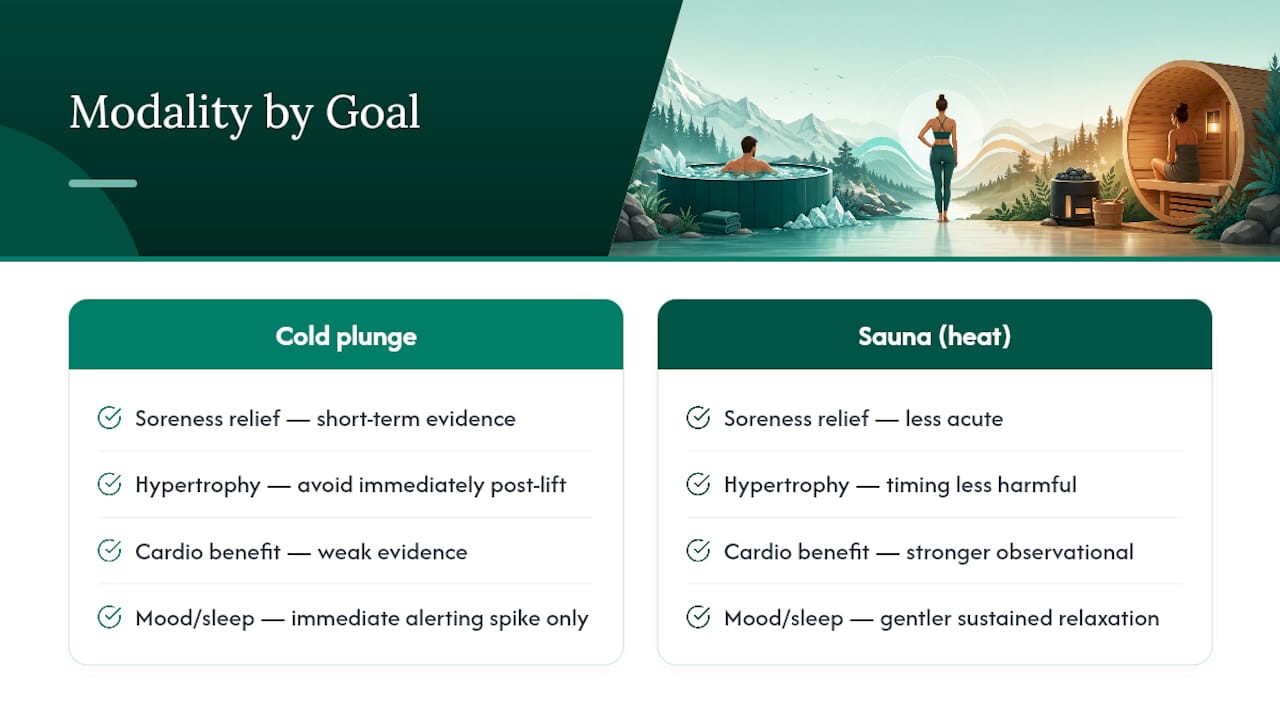
For acute muscle soreness and inflammation, cold plunge has the stronger short-term case. The same meta-analysis referenced above found measurable reductions in self-reported soreness after cold-water immersion, alongside that delayed drop in stress markers at 12 hours. Cleveland Clinic backs this up, noting cold plunges can meaningfully ease delayed-onset muscle soreness after hard training.
For strength and hypertrophy goals, timing matters more than most lifters realize. Cleveland Clinic’s guidance flags a real tradeoff: plunging immediately after resistance training may blunt the muscle-building signal your workout just created. If hypertrophy is the priority, push your cold session to a different time of day, or at minimum leave several hours between lifting and plunging.
For cardiovascular health, sauna carries the more established evidence base. The observational data on Finnish sauna users showing lower cardiovascular mortality is the strongest population-level signal either modality has, even with the caveat that it is not a randomized trial.
For mood, sleep, and stress relief, both help, but through different timelines. Cold plunge gives you an immediate spike in alertness that some people mistake for a mood boost. Harvard Health is careful to point out that this is a short-lived sympathetic surge, not evidence of durable mood or immune improvement. Sauna’s relaxation effect tends to be gentler and more sustainable as a nightly or weekly habit.
For general immune claims, be skeptical of either. The research supporting broad immune benefits from cold exposure is thin, and most of what circulates online overstates small, short-term studies.
If you only remember one distinction: use cold exposure for acute, short-term effects like soreness relief, and heat exposure (saunas) for longer-term cardiovascular and relaxation benefits.
Who Should Avoid Cold Plunges or Saunas, and Safety Rules to Follow
Certain conditions call for a conversation with your doctor before you try either therapy:
- Heart disease or a history of arrhythmias
- Uncontrolled high blood pressure
- Raynaud’s syndrome or other circulatory disorders
- Pregnancy, particularly for high-heat sauna sessions
- Any recent cardiac event, regardless of how minor it seemed
Cold-specific hazards include hypothermia, numbness that impairs coordination, and a sudden spike in heart rate and blood pressure from the sympathetic surge. Harvard Health specifically warns that this response can be dangerous for anyone with existing heart conditions. Heat-specific hazards run the other direction: dehydration, lightheadedness, and fainting (syncope) from prolonged exposure to high temperatures.
Follow these rules regardless of which modality you use:
- Start conservative. Shorter durations and moderate temperatures first, then progress.
- Never do either session alone, especially early on.
- Hydrate before and after, particularly with sauna use.
- Warm up before a cold plunge and cool down gradually after a sauna.
- Check with a doctor if you take medications that affect blood pressure or heart rhythm.
Stop immediately and seek help if you experience chest pain, dizziness, confusion, or a loss of muscle control.
Pro Tip: Keep a phone or timer within reach during cold plunges. The shock response can distort your sense of how much time has passed, and a hard stop point removes the guesswork.
How to Choose Between Cold Plunge, Sauna, or Both
Match your primary goal to your tolerance, then to what you can realistically access on a regular schedule. A perfect protocol you use once a month loses to a mediocre one you stick with weekly.
Starter protocols worth testing:
- Post-workout soreness relief: cold plunge, 1 to 3 minutes at 50 to 56°F, two to three times weekly
- Cardiovascular conditioning: sauna, 15 to 20 minutes at 150 to 175°F, three to four times weekly
- Strength or hypertrophy phases: skip cold immediately post-lift; save plunges for rest days or separate the sessions by several hours
- General relaxation and sleep support: sauna, 10 to 15 minutes, in the evening
Weigh cost, maintenance, and space honestly before buying. A full sauna installation needs dedicated square footage and ongoing upkeep. A cold plunge needs reliable filtration and a cooling system that can hold temperature without constant ice refills. If you are shopping for a home unit, ask about filtration type, how fast the cooling or heating system recovers between uses, and what the warranty actually covers. Our cold plunge routine guide breaks down how to build a schedule around whichever goal you land on.
Contrast Therapy: Combining Sauna and Cold Plunge Safely
Alternating heat and cold trains your circulatory system in a way that neither modality does alone. Heat dilates your vessels; cold constricts them immediately after. That rapid swing is the physiological rationale behind contrast therapy, and it has been practiced in some form for generations.
A 2024 review in PMC confirms the hemodynamic effects are real, but flags that long-term outcome data remains limited, and cardiac patients should approach contrast sequences with real caution.
A commonly used cycle looks like this:
- Sauna for 8 to 12 minutes (traditional) or 20 to 30 minutes (infrared)
- Cool briefly, then plunge for 1 to 3 minutes at 50 to 56°F
- Rest for a few minutes
- Repeat for 1 to 3 total cycles, adjusting downward for age or inexperience
Avoid contrast therapy entirely if you have any diagnosed heart condition without your doctor’s explicit sign off.
Pro Tip: Do your first contrast cycle solo in terms of intensity, meaning one round only. Save the multi-cycle version for once your body has a few sessions of experience with each temperature extreme individually.
How Elevate Performance Systems Matches Products to Your Protocol
Recovery setup providers can build around your specific training goals rather than selling one-size-fits-all equipment. That distinction matters once you have decided which protocol above fits your life.
- If your priority is acute soreness relief after training, a dedicated plunge system built for consistent, repeatable cold exposure fits the 1 to 3 minute protocols described earlier.
- If you are building a full contrast routine, pairing a home sauna with a plunge system lets you run the sauna-to-cold cycle without leaving your house.
- Our guide on cold plunge frequency covers how often to use your unit depending on training volume, which matters more than most buyers initially expect.
Some providers focus on personalized recovery, not a single modality, which explains why their catalogs often span plunges, saunas, and red light therapy rather than just one category.
When I Reach for Cold vs Heat, and Why It Rarely Comes Down to Science Alone
During heavy training blocks, I lean on cold plunge for the acute soreness relief the research supports. During travel or lighter weeks, sauna wins because it is easier to sit through and does not demand the same mental push. Neither choice is really about chasing the marginal physiological edge between them.
Adherence beats optimization almost every time. A slightly less optimal protocol you actually complete outperforms a perfect one you abandon after two weeks.
Pro Tip: Pick whichever modality you are less likely to skip on a bad day. That is the one building the habit that compounds.
— Derek
Ready to Bring Cold Therapy Home
If the case for cold plunge convinced you, the next real decision is finding a unit that fits your space, budget, and how often you actually plan to use it. Providers may build each setup around your specific goals instead of selling a single generic tub, which matters once you are trying to hit a real weekly protocol rather than an occasional cold shower.
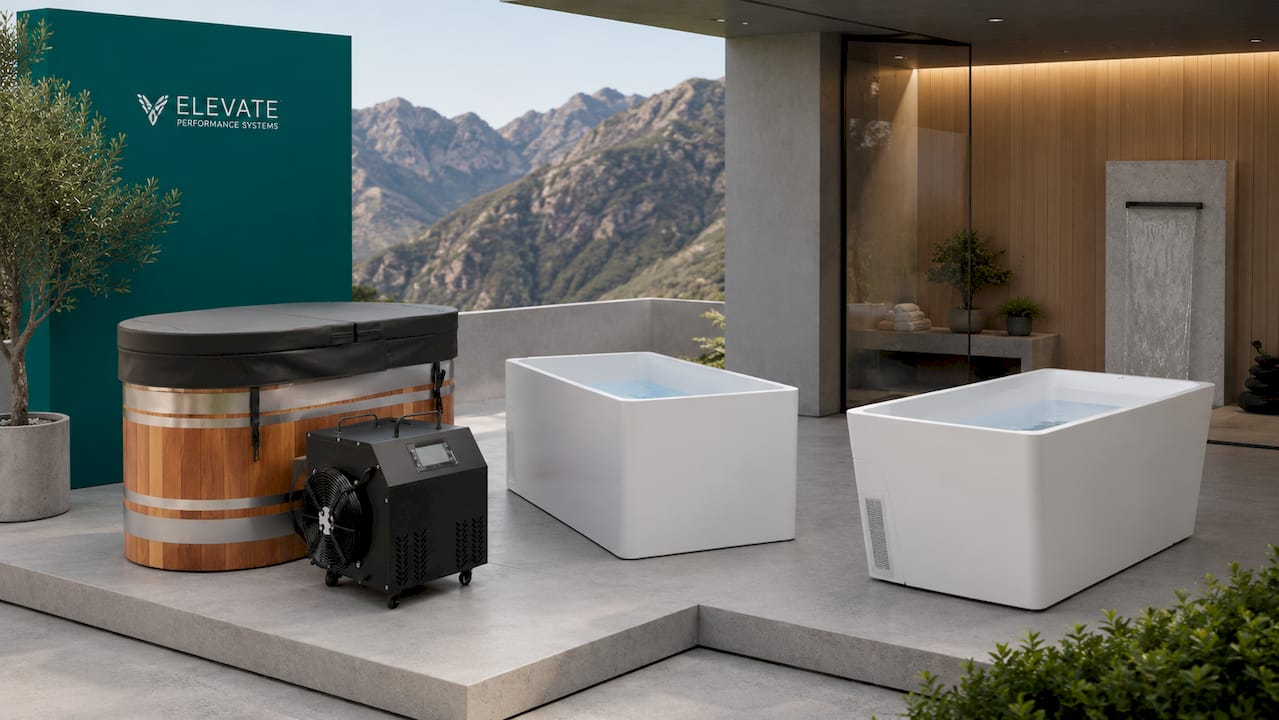
For most home setups aiming at the soreness-relief protocol described earlier, the Elevate Cold Plunge offers a straightforward entry point. If space is tight, the HAVEN COLD PLUNGE is built for smaller footprints without giving up filtration quality. Athletes running higher training volumes or anyone setting up a shared or commercial space should look at the Elevate Pro Cold Plunge, built for more frequent use. Browse the current lineup and match a model to the protocol you settled on above.
Sources
- Effects of cold-water immersion on health and wellbeing: A systematic review and meta-analysis (PLOS One, 2025)
- Cold plunges: Healthy or harmful for your heart? (Harvard Health, 2025)
- What to know about cold plunges (Cleveland Clinic, 2026)
- Cold water therapy and sauna baths review (PMC, 2024)
This article is general information, not a substitute for advice from a qualified doctor. Consult a qualified healthcare professional about your own circumstances before acting on anything here.