
If your goal is decades of cardiovascular protection backed by the deepest body of evidence, a traditional sauna wins that argument outright. If your goal is daily recovery, easy installation, and a heat experience you’ll actually stick with, infrared usually fits real life better. The two evidence anchors worth knowing are the Laukkanen cohort out of Finland and the WAON-CHF trial on far-infrared therapy. Your decision comes down to three things: your health goal, your heat tolerance, and what your home can actually support.
TL;DR:
- Traditional saunas have the strongest evidence for long-term cardiovascular and longevity benefits, especially with frequent use of four or more times weekly.
- Infrared saunas operate at lower temperatures, are easier to install, and are better suited for daily recovery and users sensitive to high heat.
- Regular sauna use, regardless of type, provides meaningful health benefits, with frequency being more important than modality choice.
- People with heart issues, pregnancy, heat sensitivity, or medication concerns should consult a healthcare professional before use.
- Cost, electrical requirements, space, and personal heat tolerance should guide the choice between infrared and traditional saunas.
Table of Contents
- Infrared vs Traditional Sauna: How Each One Actually Heats You
- Which Sauna Has Stronger Evidence for Heart Health and Longevity?
- Who Should Talk to a Doctor Before Using a Sauna?
- What Does Each Sauna Actually Cost to Own?
- How Do You Decide Between Infrared and Traditional?
- Why the “Which Is Better” Debate Misses the Real Question
- Matching a Sauna to Your Recovery Setup
- Sources
Infrared vs Traditional Sauna: How Each One Actually Heats You
The core difference is mechanical. Traditional saunas heat the air around you, usually with an electric coil or wood-burning stove topped with rocks, and you absorb that heat convectively along with radiant heat from the hot stones. Infrared saunas skip the middleman. Infrared panels emit radiant energy that penetrates skin directly and raises your core temperature without needing to heat the whole cabin’s air first.
That difference shows up immediately in the numbers. Traditional saunas typically run 175°F to 200°F, hot enough that many bathers add water to the rocks to create steam, a practice Finns call löyly, which spikes humidity and intensifies the sensation of heat. Infrared units run cooler, typically 113°F to 140°F, and stay dry throughout the session.
Session structure diverges from there:
- Traditional sessions tend to run shorter and hotter, often 10 to 20 minutes, sometimes broken into rounds with a cold plunge or cool shower between them.
- Infrared sessions run longer and gentler, commonly 20 to 45 minutes, since the lower air temperature makes extended exposure more tolerable.
- Both approaches raise core body temperature enough to trigger heat shock protein production, a cellular stress response tied to recovery and longevity research, though the magnitude of that response scales with heat intensity, so traditional’s higher temperatures generally produce a stronger acute spike.
- Installation reflects the same split: infrared units are usually plug-and-play on a standard 120V outlet, while traditional saunas typically need a dedicated 240V circuit, professional wiring, and a longer warm-up period before the cabin reaches temperature.
Neither mechanism is “better” in the abstract. They produce different physiological demands, and which one suits you depends heavily on how your body tolerates heat and how much electrical infrastructure your home can support.
Which Sauna Has Stronger Evidence for Heart Health and Longevity?
Traditional sauna use has the deeper research bench, and it’s not close. The Laukkanen cohort, a long-running Finnish study tracking roughly 2,300 men over 20 years, found that bathing 4 to 7 times per week was associated with a 65% to 66% lower risk of dementia and Alzheimer’s disease, plus a significantly reduced risk of fatal cardiovascular events, compared with once-weekly use. That’s an observational study, not a controlled trial, so it shows association rather than proof of cause. Still, the scale and duration of that dataset is something infrared research hasn’t matched yet.
Frequency drove the outcome more than any single session’s intensity. People who sauna bathed 4 or more times weekly saw the largest risk reductions, a pattern that shows up across multiple cohort analyses of the same data.
Infrared has its own evidence, just from a different kind of study. The WAON-CHF trial tested far-infrared therapy on patients with chronic heart failure and found roughly a 22% improvement in cardiac index and a 40% reduction in BNP, a biomarker of heart strain, after a structured treatment protocol. That’s a controlled clinical result in a vulnerable population, which matters, but the sample sizes in infrared research are generally smaller and the follow-up periods shorter than the multi-decade Finnish cohorts.
Where does that leave the broader picture? Systematic reviews covering both modalities conclude that repeated dry-sauna bathing, whether traditional or infrared, is linked to real cardiovascular and recovery benefits. But the same reviews caution that study heterogeneity and evidence quality make it premature to crown one modality definitively superior across the board. A few practical takeaways surface consistently:
- Traditional sauna use has the strongest population-level longevity data, largely thanks to the Finnish cohorts.
- Infrared has validated clinical results in specific populations, including heart failure patients, at lower thermal intensity.
- Smaller infrared trials also report pain and recovery improvements, though with far less long-term data than the cohort studies.
- Across every study type, frequency of use predicts benefit more reliably than which modality you choose.
That last point deserves attention because it reframes the entire debate. A sauna you use twice a month, regardless of type, delivers less benefit than one you use four times a week.
Who Should Talk to a Doctor Before Using a Sauna?
Sauna heat stresses your cardiovascular system on purpose, which is exactly why it produces adaptations over time. It’s also why certain people need medical clearance before starting a regular practice.
- Anyone with unstable cardiac disease, recent heart attack, or uncontrolled hypertension should get clearance from a physician first, since heat exposure raises heart rate and shifts blood flow toward the skin.
- Pregnant individuals, especially with pregnancy complications, should check with an OB before use, as elevated core temperature carries known risks.
- People with impaired heat sensation, including some diabetics with neuropathy, are at higher risk of unnoticed overheating and should approach sauna use cautiously and briefly at first.
- Anyone on medications that affect blood pressure, hydration, or heart rate, including diuretics and certain blood pressure drugs, should ask a pharmacist or doctor about interaction risks before regular use.
- Alcohol and sauna use is a dangerous combination. Alcohol impairs your ability to recognize overheating and increases dehydration risk, and it’s a factor in a meaningful share of sauna-related medical incidents.
Beyond the medical checklist, the basics matter every session: hydrate before and after, set a time limit you’ll actually respect, and get out immediately if you feel dizzy, nauseated, or unusually fatigued, which are early signs of heat-related syncope. Traditional sauna sessions carry more acute risk per minute because of the higher heat and steam cycles, so err toward shorter rounds. Infrared sessions run cooler but longer, which means dehydration can creep up on you gradually rather than all at once.
Pro Tip: Set a phone timer before you start, in either type of sauna. Heat dulls your sense of time faster than you’d expect, and “just a few more minutes” is how mild overheating turns into something worse.
What Does Each Sauna Actually Cost to Own?
Budget and home constraints decide more sauna purchases than any health argument does. Buyer’s guide data puts new infrared units in the low to mid thousands of dollars, while traditional builds run mid to high thousands once you add electrician work and any structural changes a dedicated 240V circuit requires.
- Infrared units plug into a standard 120V outlet, need no permits in most cases, and warm up in around 10 to 15 minutes.
- Traditional saunas need a dedicated 240V line, sometimes local permitting, and a longer warm-up window before the cabin reaches full temperature.
- Per-session energy draw tends to run higher for traditional units given the higher target temperature and larger air volume being heated, though exact draw depends on cabin size and insulation.
- Maintenance is generally lower-effort for infrared, since there’s no water or steam involved, while traditional wood-lined cabins need periodic wood care and occasional heater or rock replacement.
Living situation matters just as much as price. Apartment and rental dwellers usually lean infrared because it avoids rewiring a unit you don’t own. Homeowners with a garage, basement, or backyard have more flexibility to install a traditional sauna if the upfront cost and electrical work make sense for a long-term home.
How Do You Decide Between Infrared and Traditional?
Run through these six questions honestly, and the right modality usually becomes obvious.
- Is your primary goal long-term cardiovascular and cognitive health? If yes, traditional’s cohort data gives it the edge, assuming you can install one.
- Do you tolerate high heat well, or does 200°F sound unbearable? Heat-sensitive users generally do better with infrared’s lower range.
- Does your home have 240V capacity available, or are you renting? Limited electrical access points toward infrared’s 120V plug-and-play setup.
- What’s your realistic budget, including installation? Infrared tends to cost less upfront and requires no electrician in most cases.
- How much space do you actually have? Compact living situations favor infrared’s smaller footprint options.
- Will you realistically use it 4 or more times a week? This question matters more than modality choice, since frequency drives most of the measured benefit in both types of research.
If your answers point toward heat tolerance, space, and daily convenience, infrared is the practical choice. If they point toward maximum long-term evidence and you have the space and budget for a full install, traditional wins on paper. Either way, the sauna you’ll use consistently beats the one you’ll admire from across the garage.
Why the “Which Is Better” Debate Misses the Real Question
Most coverage of this topic frames it as a contest with a single winner, and that framing does readers a disservice. The honest read of the evidence is that traditional saunas carry the strongest longevity data because Finnish researchers have been collecting it for decades, not necessarily because heat delivered through air is biologically superior to heat delivered through infrared panels. Give infrared research another 20 years of cohort tracking and the gap may well close.
What the conventional advice skips is adherence. A sauna’s health value compounds with frequency, and frequency depends entirely on whether the sauna fits your actual life. A person who sits in a traditional sauna twice a month for lack of easy access gets a fraction of the benefit of someone using an infrared unit in their spare room four times weekly. The real-world fit often matters more than which modality wins on paper, and that’s the question worth asking before the one about cardiac index percentages.
Prioritize the sauna you’ll actually use on a cold Tuesday night, not the one that wins an argument.
— Derek
Matching a Sauna to Your Recovery Setup
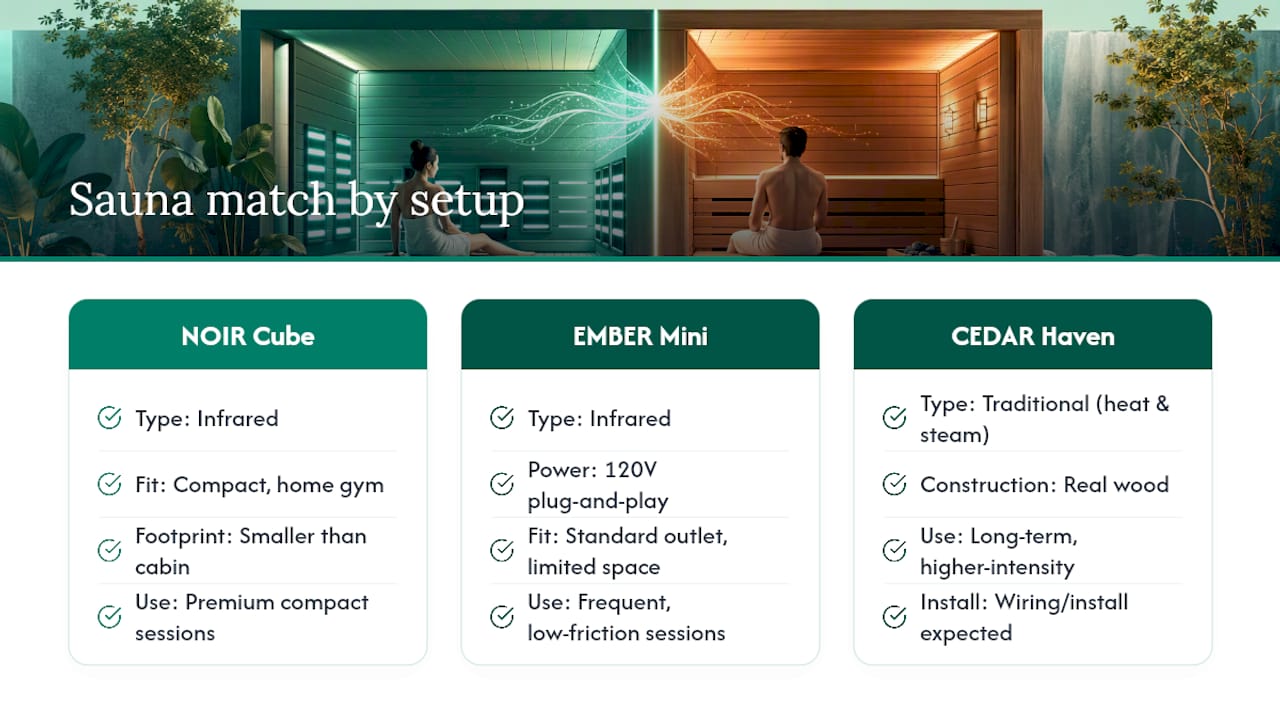
Recovery systems can be built around how you’ll actually use them, rather than around a single “best” modality, which is exactly the mindset this comparison points toward. Instead of picking a sauna off a shelf, one can get a setup matched to heat tolerance, space, and training goals.

The NOIR CUBE SAUNA suits anyone who wants a premium, compact infrared unit that fits a home gym or spare room without the footprint of a full cabin. For daily recovery users working with limited space or a standard outlet, the EMBER MINI SAUNA offers plug-and-play 120V infrared heat built for frequent, low-friction sessions. If you’re after the traditional heat-and-steam experience with real wood construction for long-term, higher-intensity use, the CEDAR HAVEN SAUNA delivers that without guesswork about wiring or install.
Run through the six-question checklist above, then browse the full sauna collection or reach out to Eperformancesystems directly. A quick conversation about your goals, space, and budget gets you a recommendation built around your household, not a generic best-seller list.
This article is general information, not a substitute for advice from a qualified doctor. Consult a qualified healthcare professional about your own circumstances before acting on anything here.
Sources
- Sauna use linked to longer life, fewer fatal heart problems | Harvard Health
- WAON-CHF trial — PubMed