
Low-EMF infrared saunas deliver the same heat-based recovery benefits as standard models, so the purchase decision comes down to verification, not compromise. If you’re EMF-conscious, the one thing to check in any product listing is whether the manufacturer publishes third-party magnetic field (MF) and electric field (EF) readings taken at the seated position, not just at a one-meter distance.
TL;DR:
- Seated-position EMF and EF readings from verified third-party labs provide the most accurate exposure estimates, not measurements taken at one meter or with heaters off.
- Manufacturers often set their own thresholds for “low EMF,” with readings at or below 10 milligauss and 300 volts per meter being reasonably low, and ultra-low means below 3 milligauss and 10 volts per meter.
- Reliable test reports must specify the test lab, measurement distance, heater operation status, and include both magnetic and electric field results; absence of this info suggests unverified claims.
- Lower EMF levels do not alter sauna heat output or recovery benefits, which mainly depend on temperature, infrared penetration, and sweating, not electrical modifications.
- The most trusted sauna choices for EMF-conscious buyers are those with independently verified seated-position readings, appropriate wiring, shielding, and grounding practices, rather than vague marketing claims.
Table of Contents
- What Low EMF Infrared Sauna Shoppers Need to Know About EMF and EF
- How Is Sauna EMF Measured, and What Should a Test Report Include?
- What Do “Low EMF” and “Ultra-Low EMF” Actually Mean?
- How to Evaluate Manufacturer EMF Claims Before You Buy
- Is Sauna Safety Really About EMF, or Something Else Entirely?
- How to Choose a Low EMF Infrared Sauna: Ranked Buying Criteria
- Do Low-EMF Saunas Still Deliver the Same Therapeutic Benefits?
- Why We Point EMF-Conscious Buyers Toward Verified Low-EMF Models
- Recommended Low-EMF Sauna Options From Our Catalog
- Sources
What Low EMF Infrared Sauna Shoppers Need to Know About EMF and EF
“EMF” gets used as a catch-all term, but it actually covers two distinct things: magnetic fields and electric fields. Both matter, and a credible low EMF infrared sauna claim has to address them separately.
Magnetic fields, measured in milligauss (mG), come from current flowing through the heater elements and wiring. Electric fields, measured in volts per meter (V/m), come from voltage present in the wiring and components, even when current isn’t flowing. Both weaken sharply as you move away from the source, which is why where a company measures matters as much as what it measures.
Inside a sauna cabin, the heaters and their wiring runs sit close to where you sit. That proximity is exactly why infrared units generate more measurable field strength near the body than, say, a lamp across the room. For context, here’s how common devices compare:
- A hair dryer can produce magnetic fields in the tens of milligauss at close range.
- A microwave oven often reads higher still at close range, dropping off fast with distance.
- A cell phone against the body generates a modest electric field, far below sauna heater panels at seated distance.
The NIEHS overview of electric and magnetic fields is a useful primer if you want the underlying physics explained without marketing spin.
How Is Sauna EMF Measured, and What Should a Test Report Include?
A trustworthy EMF test isn’t just a number on a spec sheet. It’s a documented process you can trace back to a real lab.
Magnetic field results are reported in milligauss, electric field results in volts per meter. Distance changes both readings dramatically, which is why a reading taken one meter from the heater panel tells you almost nothing about what you’ll experience with your back against it. Seated-position measurement, meaning the sensor sits where a person’s torso or back would rest during a session, is the only distance that reflects real exposure.
A credible report should name:
- The testing lab or independent evaluator, by name.
- The date of testing and the instrument model used (a gaussmeter model, for instance).
- The exact measurement distance and body position (seated, not standing near the door).
- Confirmation that heaters were powered on at typical operating temperature during the test.
- Both MF and EF results, not just one of the two.
Watch for reports that measure “near the panel” without specifying seated distance, or that quietly test with heaters off. Both patterns produce artificially low numbers.
Pro Tip: Ask the seller to send you the actual lab report, not a summary graphic. If they can’t produce it, treat any “low EMF” claim on that listing as unverified.
What Do “Low EMF” and “Ultra-Low EMF” Actually Mean?
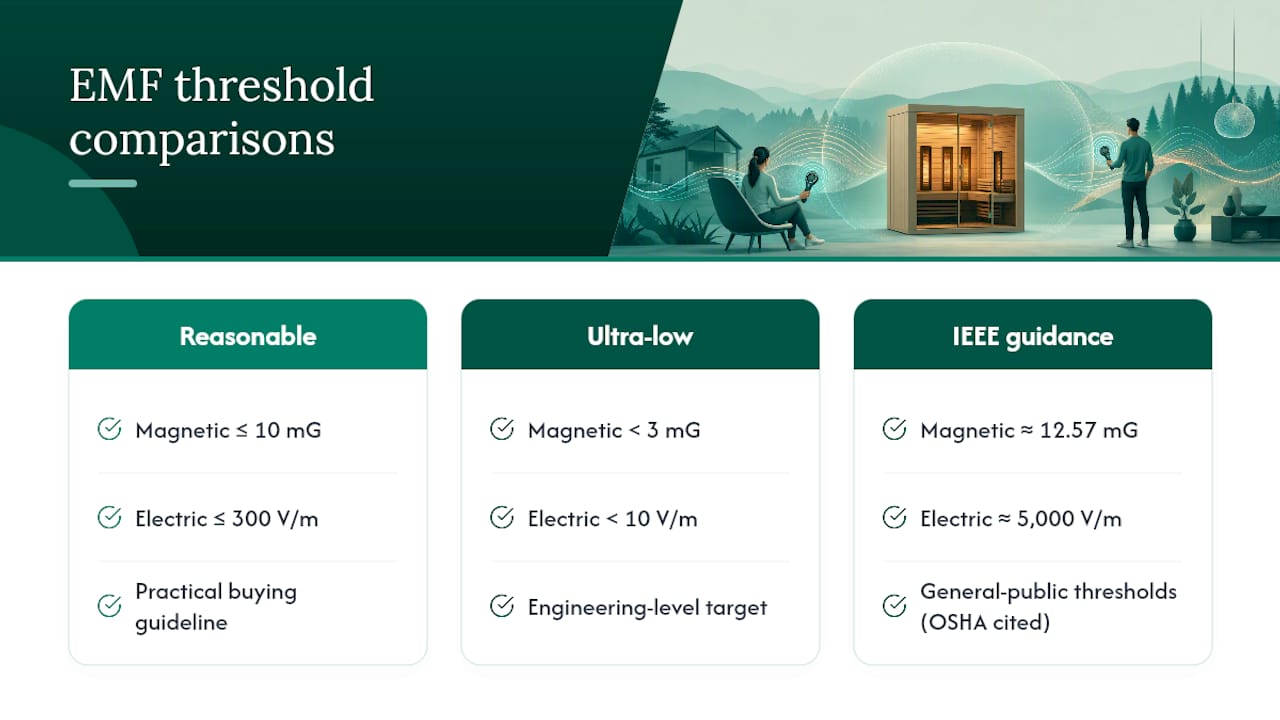
There’s no single regulatory number that defines “low EMF” for saunas. Manufacturers set their own benchmarks, and the terms get applied loosely across the industry.
As a conservative buying guideline, treat readings at or below 10 mG and 300 V/m as reasonably low, and readings under 3 mG and 10 V/m as ultra-low engineering territory. These aren’t official thresholds. They’re practical cutoffs worth using when you’re comparing listings, since actual manufacturer numbers vary widely even within the same price tier.
Independent test reports on some models have recorded very low magnetic field readings at the seated position, according to Forbes’ reporting on ultra-low EMF sauna technology. That’s well inside the ultra-low range, though methods and test distances differ between reviewers, so always check how a given number was produced.
For scale, OSHA’s summary of general-public EMF exposure guidance cites IEEE thresholds around 12.57 mG and 5,000 V/m, both far above what most sauna marketing calls “ultra-low.” That gap tells you something important: most “low EMF” saunas already sit well under general-public safety thresholds. The real question isn’t whether a unit is dangerous. It’s whether the manufacturer engineered it further down and can prove it. Shielded panels, individually grounded components, and wiring routed away from the seating area all raise manufacturing cost, which is part of why ultra-low models often carry a price premium.
How to Evaluate Manufacturer EMF Claims Before You Buy
Marketing copy that says “low EMF technology” without numbers is a claim, not evidence. Before you trust it, run through this checklist:
- Request both MF and EF readings, not just one.
- Confirm the readings were taken at seated position, not at one meter.
- Ask for the name of the third-party lab that ran the test.
- Ask whether heaters were on and at what temperature during testing.
- Ask for a description of the wiring layout and any shielding or grounding used.
If a seller can’t answer these directly, that’s informative on its own. Common red flags include:
- Only magnetic field numbers reported, with electric field ignored entirely.
- Measurements taken at one meter, described loosely as “low EMF” without distance disclosed.
- No named lab, no date, no instrument model.
- Vague phrases like “engineered for low EMF” with zero supporting data.
Publishing complete test reports, naming the lab and the measurement distance, is one of the strongest trust signals a manufacturer can offer, and it costs the company nothing to disclose if the numbers are genuinely good. Ask the seller to put their claims in writing, ideally in an email you can keep on file, before you commit to a purchase.
Is Sauna Safety Really About EMF, or Something Else Entirely?
Heat, not EMF, is the primary safety variable in sauna use. Infrared cabins typically run in the 120 to 140 degree Fahrenheit range, noticeably milder than traditional steam saunas, but still hot enough to cause dehydration or overheating if you’re careless with session length.
- Start with 10 to 15-minute sessions and build up gradually as your tolerance improves.
- Drink water before and after, and consider electrolytes for longer sessions.
- Cap sessions around 30 to 45 minutes unless a doctor has advised otherwise for your situation.
- Pregnant individuals and people with cardiovascular conditions should consult a doctor before starting sauna use.
The Cleveland Clinic’s guidance on infrared sauna precautions makes this point directly: dehydration and overheating are the documented risks, not household-level EMF exposure.
Pro Tip: Set a timer for your first few sessions. It’s easy to lose track of time in the heat, and that’s when overheating risk climbs fastest.
How to Choose a Low EMF Infrared Sauna: Ranked Buying Criteria
Not every criterion deserves equal weight. Rank them in this order when comparing units:
- Verified MF and EF readings at seated position, from a named third-party lab.
- Heater type and wiring layout, since routing choices directly affect field strength near the seat.
- Shielding and grounding practices, described in the spec sheet, not just claimed in marketing copy.
- Temperature range and controls, since heating type and speed affect the recovery experience as much as EMF does.
- Warranty terms and return policy, in case the unit doesn’t perform as advertised once installed.
If you’re comparing heating speed against recovery features, our guide to choosing a fast-heating sauna covers that trade-off in more depth.
| Buyer priority | What to demand | Why it matters |
|---|---|---|
| Verified field readings | Seated-position MF and EF numbers | Confirms real exposure, not marketing distance |
| Test authority | Named third-party lab | Filters out self-reported claims |
| Engineering detail | Wiring and shielding description | Explains why one unit tests lower than another |
| Ongoing protection | Warranty and return terms | Protects you if specs don’t match reality |
Budget buyers can reasonably accept standard low-EMF engineering if the seated readings sit under the 10 mG and 300 V/m thresholds. Reserve the premium for ultra-low models if EMF sensitivity, or simple peace of mind, is a priority you’re willing to pay for.
Do Low-EMF Saunas Still Deliver the Same Therapeutic Benefits?
Yes. Lowering EMF output is an electrical engineering change, not a heat-output change, and it doesn’t alter how infrared saunas warm the body or how a session feels.
The therapeutic case for infrared saunas rests on core-temperature elevation, increased circulation, and sweat response, all driven by infrared heat penetrating tissue at that 120 to 140 degree range. Shielding a heater panel, grounding it individually, or rerouting wiring away from the seat changes none of that. These are electrical modifications layered onto the same heating mechanism, not a redesign of how the sauna heats you.
Where low-EMF engineering does show up is in component choice and sometimes heater density, since some ultra-low designs use panel configurations that spread heat slightly differently than a standard unit. In practice, this rarely translates to a noticeably different session experience. The main practical upside of choosing a low-EMF model isn’t a stronger workout or faster recovery. It’s confidence that you’ve minimized a variable you were concerned about, without giving up anything on the heat side. If EMF exposure isn’t a concern for you personally, a standard infrared sauna will deliver comparable recovery benefits at a lower price point. If it is a concern, you can address it without settling for a weaker sauna.
Why We Point EMF-Conscious Buyers Toward Verified Low-EMF Models
We work with athletes and recovery-focused buyers who often ask about EMF when comparing sauna specs. Our approach is to match each buyer’s actual priorities, whether that’s EMF sensitivity, space constraints, or heating speed, against verified specs rather than marketing language.
We carry a range that spans compact units through traditional wood-fired options, so recommendations stay grounded in what actually fits your space and goals. If you’re unsure which model balances your EMF concerns against your recovery routine, requesting a personalized recommendation gets you a straighter answer than scrolling spec sheets alone.
— Derek
Recommended Low-EMF Sauna Options From Our Catalog
Matching your checklist to an actual product is easier once you know what to check for. Here are three models that meet EMF-conscious buying criteria.
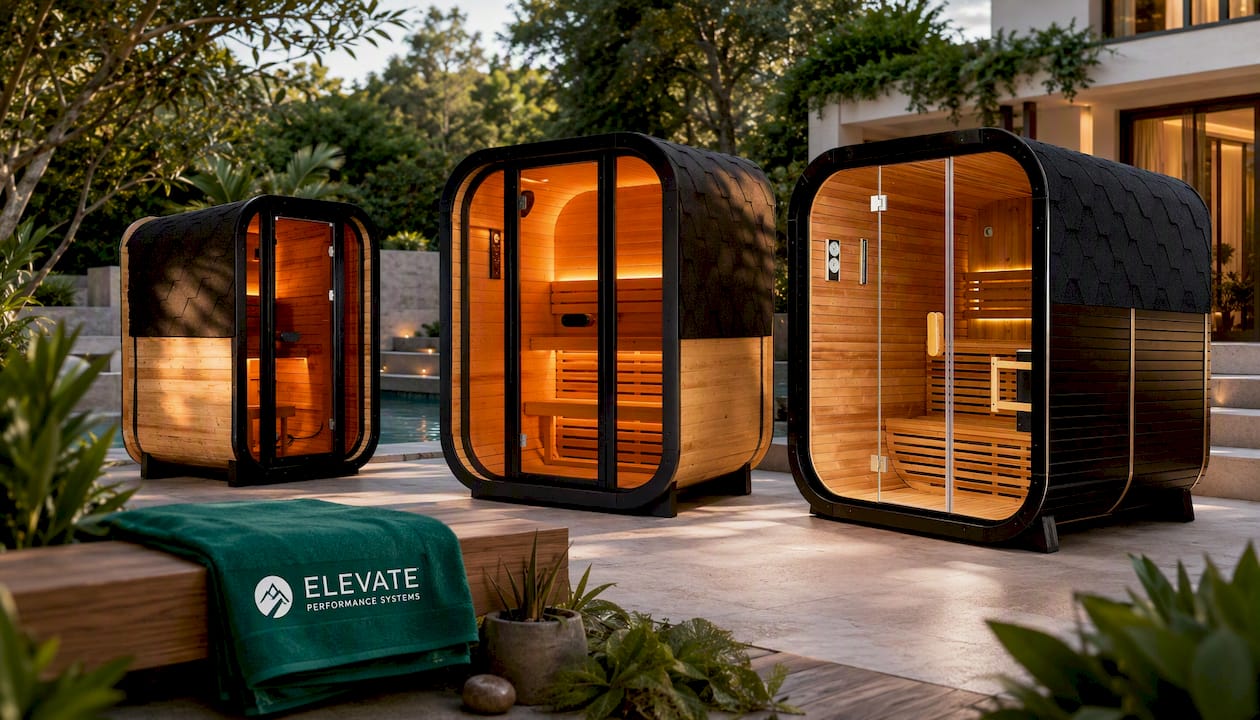
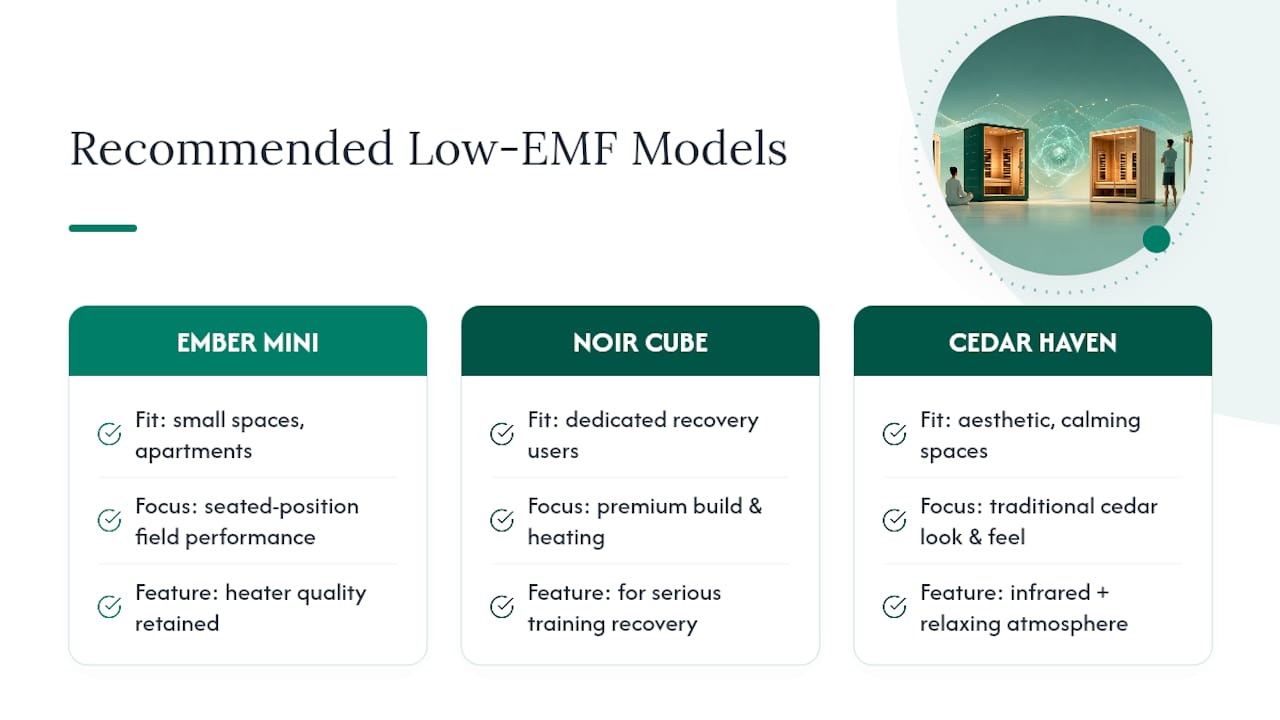
The EMBER MINI SAUNA suits buyers working with limited square footage, apartments, condos, or a corner of a home gym, without asking them to sacrifice heater quality or seated-position field performance for the smaller footprint.
The NOIR CUBE SAUNA targets buyers who want premium build quality and heating performance in one unit, the kind of purchase suited to someone treating recovery as a serious part of their training program rather than an occasional indulgence.
The CEDAR HAVEN SAUNA is built for buyers who want the traditional cedar look and feel alongside infrared heating, a fit for anyone who wants their sauna to double as a calming space, not just recovery equipment.
Ask us for the current test documentation on any of these three models, including seated-position MF and EF readings, before you buy. Pairing a sauna with red light therapy rounds out a recovery setup further, if that’s a direction you’re already considering. Browse the specs on each product page, or reach out directly for a recommendation built around your space, budget, and how much EMF verification actually matters to you.
This article is general information, not a substitute for advice from a qualified doctor. Consult a qualified healthcare professional about your own circumstances before acting on anything here.
Sources
- OSHA — Radiation standards / ELF fields
- Verywell Fit — The 12 Best Infrared Saunas of 2026, Tested
- Cleveland Clinic — Infrared saunas: benefits and precautions
- Forbes — Best home sauna (includes notes on ultra-low EMF tech)