
Most therapeutic protocols fall within a range of joules per square centimeter (J/cm²) per session, typically delivered multiple times per week for skin and pain concerns, or daily for a short initial course. That range covers most common goals, but the number that matters for you depends on your device’s actual irradiance, not the wattage printed on the box. Before you commit to a schedule, confirm your panel or mask can deliver that dose at the distance you actually use it.
TL;DR:
- Effective red light therapy doses typically range from 4 to 30 J/cm², with higher exposures beyond 60 J/cm² offering diminishing or negative returns.
- Device irradiance at the treatment distance, not wattage, determines session length, with 100 mW/cm² requiring under 7 minutes to reach 40 J/cm².
- Consistent sessions of 3 times weekly for 4 to 12 weeks generally yield results, with maintenance lowering to 2 sessions weekly afterward.
- Skin pigmentation might necessitate slightly longer exposures for deeper skin tones, but standardized adjustments are not yet established.
- Overexposure exceeds recommended doses and can suppress cellular response, so measuring your device’s irradiance and calculating session time is essential.
Table of Contents
- Red Light Therapy Dosage at a Glance
- How Do You Calculate Your Red Light Therapy Dose?
- How Do You Verify Your Device Delivers a Real Dose?
- How Often Should You Use Red Light Therapy?
- Dosing Protocols by Condition
- What Are the Real Risks and Limits of Red Light Therapy?
- Worked Dosing Examples You Can Copy
- How Elevate Performance Systems Approaches Dosing
- Skin Type and Pigmentation: Does Dose Need to Change?
- Why Most People Get Red Light Dosing Backwards
- Find the Right Red Light Panel for Your Dosing Protocol
- Sources
Red Light Therapy Dosage at a Glance
Dosing gets confusing fast because every condition has its own therapeutic window, and every device outputs light differently. The table below breaks down realistic starting points for the five goals people search for most, based on canonical dosing compilations and clinical trial data.
| Goal | Fluence (J/cm²) | Session length | Frequency |
|---|---|---|---|
| Skin rejuvenation | 4–18 | 10–15 min | 3x/week |
| Hair regrowth | a low to moderate dose range | session duration varies | about three times weekly |
| Wound healing | 1–10 per site | 3–8 min per site | 3–5x/week |
| Joint/muscle pain | a moderate to higher dose range per point | session duration varies | multiple times weekly |
| Muscle recovery | 20–60 (area) | 10–20 min | 4–6x/week |
Notice how session length shifts even within the same J/cm² target. That’s because time depends entirely on your device’s irradiance, measured in milliwatts per square centimeter (mW/cm²). At 30 mW/cm², reaching 10 J/cm² takes about 5.5 minutes. At 50 mW/cm², the same dose takes about 3.3 minutes. At 100 mW/cm², it drops to under 2 minutes. If your sessions run long at close range without improvement, you may be exceeding the useful dose instead of being underexposed.
Canonical dosing compilations place the sweet spot for most indications at 4 to 30 J/cm², with output beyond roughly 60 J/cm² tied to diminishing or reversed benefit. That single fact reshapes how you should think about “more is better.” It usually isn’t.
Maintenance schedules typically follow an initial course of 4 to 12 weeks. Once you see the change you’re after, whether that’s smoother skin or less knee stiffness, dropping to 2 sessions a week is a common way to hold results without over-treating. Nobody has published a definitive long-term maintenance standard, so treat this as a reasonable starting framework rather than a fixed rule.
How Do You Calculate Your Red Light Therapy Dose?
The formula behind many credible protocols is simple: J/cm² = irradiance (mW/cm²) × time (seconds) ÷ 1000.
That’s it. Once you know your device’s irradiance at your actual treatment distance, you can solve for time and stop guessing. LightTherapyIQ’s dosing guide walks through this exact math, and it’s worth internalizing because underdosing, not overdosing, is the more common consumer mistake.
Here’s the formula in action:
- Example 1: A panel rated at 50 mW/cm² at 12 inches. To hit 10 J/cm²: 10 = 0.050 × time ÷ 1, so time = 200 seconds, or about 3.3 minutes.
- Example 2: A face mask rated at 30 mW/cm² against the skin. To hit 6 J/cm²: 6 = 0.030 × time ÷ 1, so time = 200 seconds, about 3.3 minutes.
- Example 3: A high-output panel at 100 mW/cm² for a muscle recovery target of 40 J/cm²: 40 = 0.100 × time ÷ 1, so time = 400 seconds, roughly 6.7 minutes.
Statistic Callout: A device delivering 100 mW/cm² needs just under 7 minutes to reach a 40 J/cm² muscle recovery dose. The same target at 30 mW/cm² would take over 22 minutes, which is why irradiance, not session count, drives most real-world dosing failures.
Distance changes everything here. Light intensity falls off according to the inverse square law, meaning irradiance drops sharply as you move away from the panel. Step back from 6 inches to 18 inches and you can lose more than half your effective dose, even though the device specs haven’t changed. This is also why a manufacturer’s “total wattage” figure is nearly meaningless on its own. A 300 watt panel and a 500 watt panel can deliver identical irradiance at your skin if the difference comes from panel size rather than diode density. Ask for irradiance at a stated distance, not total power draw.
How Do You Verify Your Device Delivers a Real Dose?
Marketing copy and measured output frequently disagree. Scientific American’s reporting on photobiomodulation research points out that unresolved questions about wavelength, intensity, and pulse rate mean many commercial products underdeliver against their claims. Confirming your specific unit is worth five minutes before you build a routine around it.
Before you trust any session plan, get answers to these:
- Ask for the exact wavelength(s). Look for 630–670 nm (red) and/or 810–850 nm (near-infrared), since these ranges have the deepest published research base.
- Request irradiance at a stated distance. A number like “50 mW/cm² at 6 inches” is usable. “100 watts” alone is not.
- Check for a power density map or third-party test. Reputable manufacturers publish independent measurements, not just internal specs.
- Measure it yourself if you can. A handheld radiometer, such as a Solarmeter, gives you a direct irradiance reading at your treatment distance.
- Watch for red flags. Vague claims like “clinical grade” with no wavelength listed, no irradiance data, or suspiciously large treatment-distance claims all warrant skepticism.
Pro Tip: If you can’t get irradiance numbers from a manufacturer, treat that as your answer. A company confident in its output usually publishes it upfront, unprompted.
How Often Should You Use Red Light Therapy?
Start conservative: 3 sessions a week for the first 2 to 4 weeks, regardless of your goal. This gives you a baseline to judge tolerance and response before adjusting.
From there, frequency depends on what you’re treating:
- Skin and hair: 3 times a week is standard across most clinical protocols, with daily use rarely showing added benefit over that cadence.
- Pain and musculoskeletal recovery: Some protocols move to daily or near-daily sessions for a short, defined course, especially in the first two weeks of an acute flare.
- Twice-daily sessions: Only appropriate for specific pain or wound protocols, and evidence-based spacing calls for at least 6 hours between exposures on the same site to avoid cumulative overdosing.
- Course length: Most trials run 4 to 12 weeks before evaluating results; expecting change in the first week sets you up for disappointment.
A consumer guide from Infraredi’s dosing overview echoes this pattern: 3 to 5 sessions weekly for 1 to 10 minutes per site, scaled to the device and target area. Once you’ve completed an initial course and you’re satisfied with results, tapering to 2 sessions a week for maintenance is a reasonable, low-risk next step. If you stop entirely, expect gradual regression. Stanford Medicine’s overview notes that consistency matters more than intensity, and benefits tend to fade once treatment stops.
Dosing Protocols by Condition
General ranges only get you so far. Here’s how dosing actually shifts once you account for tissue depth and treatment goal.
Skin rejuvenation
Wavelengths in the 630–670 nm range, paired sometimes with near-infrared, target collagen production and fine lines. Clinical trials commonly used 10 to 12 minutes per session, twice-weekly, producing measurable improvements in skin elasticity within 4 to 12 weeks. In J/cm² terms, that typically lands in the 4 to 18 range per session. There’s no standardized long-term maintenance protocol yet, so most people settle into 2 to 3 sessions a week once initial results appear, then watch for regression if they cut back further.
Hair regrowth
Scalp tissue calls for lower irradiance than skin or muscle protocols, both because the treatment area is curved and uneven and because hair follicles sit closer to the surface. Typical per-session doses run 3 to 8 J/cm² across the scalp, applied 3 times weekly. This is a slow-build category. Meaningful density changes in androgenetic alopecia trials, covered in the umbrella review of photobiomodulation RCTs, generally take several months of consistent use, and certainty of benefit ranged from low to moderate depending on the study.
Wound healing and dermatologic targets
Open or healing wounds respond to lower per-point doses, often 1 to 10 J/cm², applied more frequently than cosmetic protocols, sometimes 3 to 5 times a week. Because wound tissue is fragile and inflammation status changes daily, this is one category where checking with a wound-care provider before self-treating matters more than in cosmetic use. Higher frequency at a lower per-session dose tends to outperform infrequent high-dose exposure here.
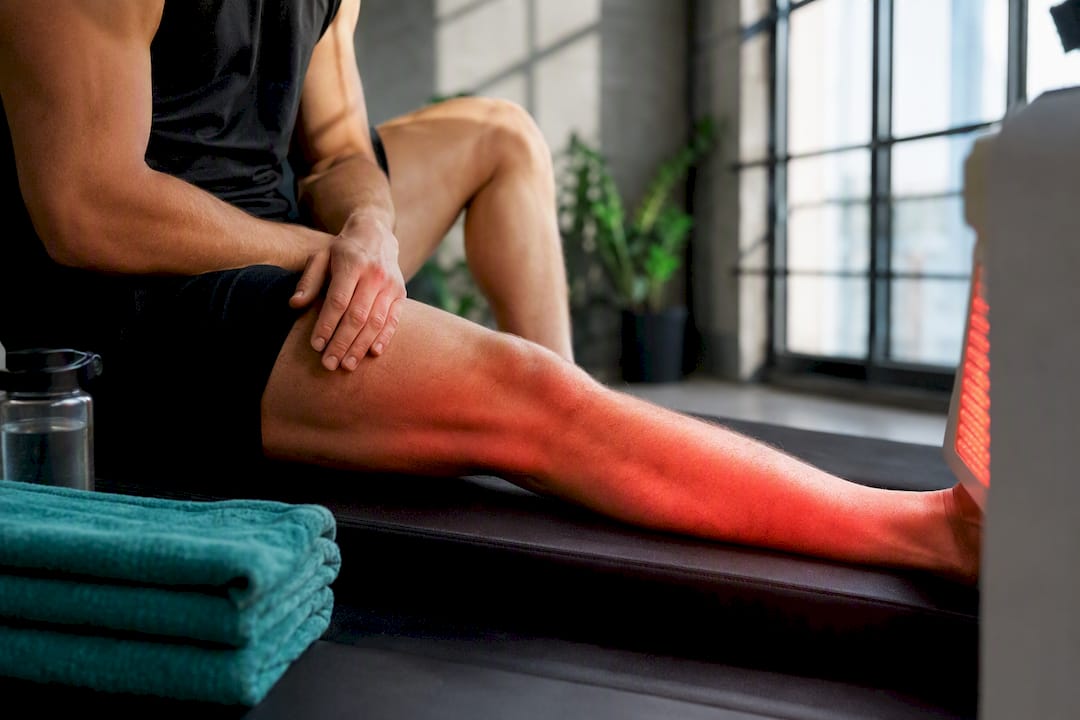
Joint and musculoskeletal pain, including tendinopathy
This is where dosing gets counterintuitive. Red light in the 630–670 nm range loses roughly half its strength within the first 1 to 2 millimeters of tissue, so a joint or tendon sitting several centimeters below skin needs a much higher surface dose to receive a therapeutic amount at depth. Protocols for knee osteoarthritis and tendinopathy commonly call for 4 to 30 J/cm² per treatment point or cluster, depending on depth and target size, delivered 3 to 5 times weekly. The umbrella review covering knee osteoarthritis and tendinopathy found statistically significant benefit, though protocol heterogeneity across trials makes a single universal number impossible to state with full confidence.
Muscle recovery
Athletes and anyone training hard need to think in terms of area dosing rather than single-point dosing. Because muscle tissue sits deeper than skin, effective protocols often use 20 to 60 J/cm² across the treatment area to compensate for attenuation, delivered 4 to 6 times weekly during heavy training blocks. Timing relative to exercise matters here too: many people treat within an hour after training to support recovery, though pre-exercise use is also common in athletic settings. A performance-oriented panel built for larger coverage areas fits this use case better than a small, low-output unit, simply because reaching 40 or 50 J/cm² across a full quad or shoulder in a reasonable session length requires higher total irradiance.
What Are the Real Risks and Limits of Red Light Therapy?
The biphasic dose response, sometimes called the Arndt-Schulz principle, is the single most misunderstood concept in this field. Low to moderate doses stimulate cellular activity. Push past a certain threshold, generally cited around 60 J/cm² in canonical dosing tables, and the same light can suppress the response you were trying to trigger. More exposure is not automatically better, and in this case it can actively work against you.
Statistic Callout: Canonical dosing research places the effective ceiling for most conditions well under 60 J/cm² per session, meaning doubling your treatment time past that point can reduce, not increase, your results.
A few groups should talk to a clinician before starting:
- Anyone taking photosensitizing medications, since these can amplify skin reactions to light exposure.
- People in active cancer treatment or with a recent cancer diagnosis, given limited safety data in this population.
- Anyone with an open, untreated, or infected wound that hasn’t been evaluated by a provider.
Evidence certainty varies widely by condition. The umbrella review of RCTs found significant results across nine conditions, but certainty ranged from very low to moderate, not high. Expect gradual change over weeks, not days, and treat red light therapy as one part of a broader routine, not a standalone fix. Harvard Health’s overview frames it as an adjunct to sun protection, sleep, and exercise rather than a replacement for any of them.
Worked Dosing Examples You Can Copy
Run through these calculations once with your own device numbers and you’ll never need to guess a session length again.
- Target: 8 J/cm² skin protocol, device at 40 mW/cm². Time = 8 ÷ 0.040 = 200 seconds, or about 3.3 minutes.
- Target: 15 J/cm² pain protocol, device at 75 mW/cm². Time = 15 ÷ 0.075 = 200 seconds, also about 3.3 minutes. Same time, different dose, because irradiance scales with it.
- Target: 30 J/cm² muscle protocol, device at 60 mW/cm². Time = 30 ÷ 0.060 = 500 seconds, roughly 8.3 minutes.
- Target: 5 J/cm² scalp protocol, device at 25 mW/cm². Time = 5 ÷ 0.025 = 200 seconds, about 3.3 minutes.
Before every session, run through this checklist:
- Confirm your treatment distance matches the distance your irradiance figure was measured at.
- Check that your target area fits within the device’s effective beam, not just its visible light.
- Set a timer using your calculated minutes rather than a round number that feels right.
- Log the date, area treated, and session length so you can track a full course over weeks.
The reusable formula stays the same regardless of goal: time (seconds) = target J/cm² ÷ irradiance (mW/cm² converted to W/cm²). Write your device’s measured irradiance on a sticky note near your treatment space, and you’ll never have to redo this math from scratch.
How Elevate Performance Systems Approaches Dosing
Recovery equipment only helps if it’s matched to what someone actually needs, which is the premise behind Eperformancesystems’s approach to red light therapy. Rather than selling a single panel and calling it universal, the product lineup reflects the fact that a facial skin protocol and a hamstring recovery protocol call for genuinely different irradiance and coverage.
A compact panel suits targeted-site work, like a single joint or a small treatment zone, where lower total coverage is fine because the target area is small. A larger performance panel matches the area dosing that muscle recovery protocols require, where reaching 20 to 60 J/cm² across a full limb needs more diodes and higher total output. A face mask serves an entirely different purpose: consistent, close-range, low-to-moderate dose exposure across curved facial contours where a flat panel can’t maintain even distance.
Anyone building a home recovery routine benefits from pairing red light protocols with other modalities, an idea covered in more depth in Elevate’s piece on compression boots for muscle recovery.
Skin Type and Pigmentation: Does Dose Need to Change?
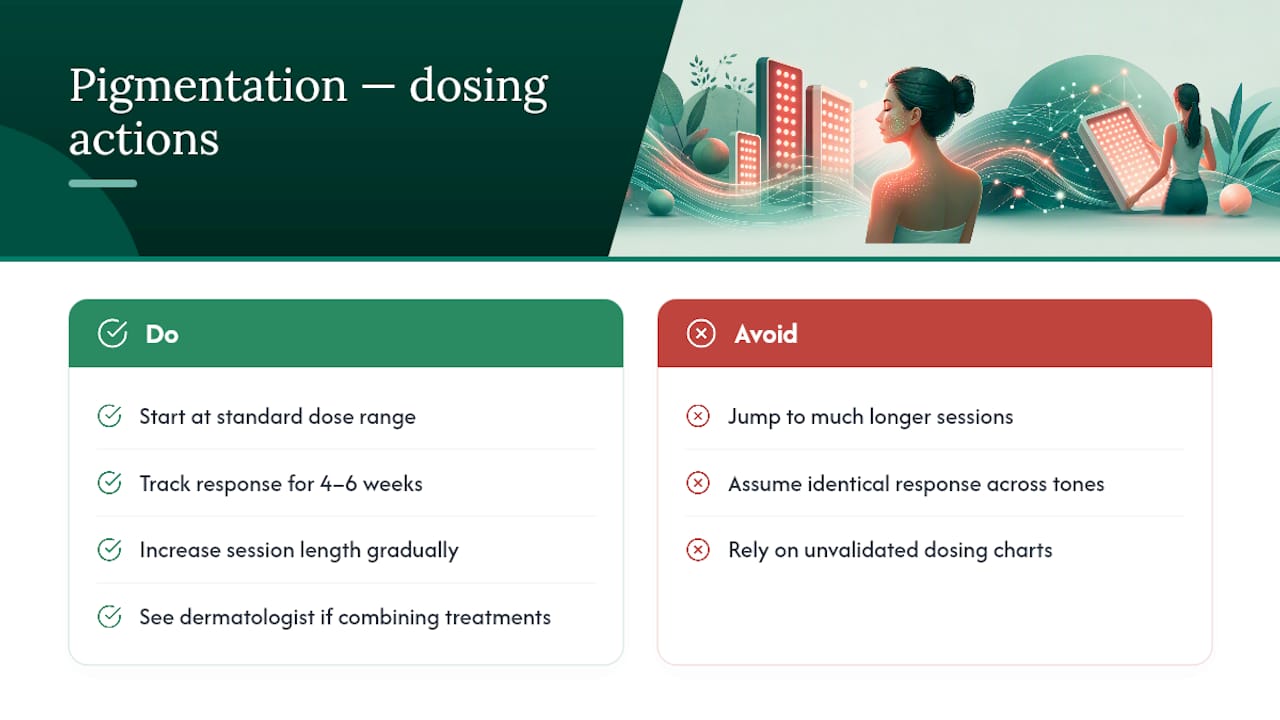
Melanin absorbs and scatters light, which means deeper skin tones may need slightly longer exposure times or marginally higher fluence to deliver the same effective dose at the target layer compared to lighter skin. This isn’t a settled clinical standard yet. Scientific American’s coverage of photobiomodulation research specifically flags how skin color affects dosing as one of the field’s open questions, not a solved one.
In practice, this means two things for you. First, if you have deeper skin pigmentation and you’re not seeing the results your lighter-skinned friend reports at the same session length, the difference may be genuinely physiological rather than a sign you’re doing something wrong. Second, nobody currently publishes a validated pigmentation-adjusted dosing chart, so the safest approach is starting at the standard dose range for your condition, tracking your own response over 4 to 6 weeks, and adjusting session length modestly upward if progress is slower than expected. Increase gradually rather than jumping straight to a much longer session, since the biphasic response applies regardless of skin tone. If you’re using red light therapy alongside other treatments for pigmented or sensitive skin, a conversation with a dermatologist or a provider familiar with physician-supervised home therapies can help you calibrate faster than trial and error alone.
Why Most People Get Red Light Dosing Backwards
The conventional advice treats red light therapy like a supplement: take it daily, more is better, results will come eventually. The research doesn’t support that framing. The umbrella review data makes clear that benefit is condition-specific, dose-dependent, and capped, not open-ended. Treating your panel like a tanning bed you sit under for 20 minutes because “it can’t hurt” ignores the biphasic response entirely.
What the evidence actually supports is unglamorous but effective: measure your device’s real irradiance, calculate your session time with basic arithmetic, and stay inside the 4 to 30 J/cm² window that shows up across nearly every credible dosing compilation. Most underwhelming results trace back to underdosing from excessive distance or inflated wattage claims, not to red light therapy failing as a modality.
If you take one thing from this guide, let it be this: stop trusting the timer someone else set for a different device. Do the math for yours.
— Derek
Find the Right Red Light Panel for Your Dosing Protocol
Once you know your target J/cm² and session length, the equipment decision becomes straightforward rather than overwhelming. Eperformancesystems builds its red light therapy lineup around exactly the dosing math covered above, so you’re matching irradiance and coverage to your actual protocol instead of buying based on marketing claims alone.
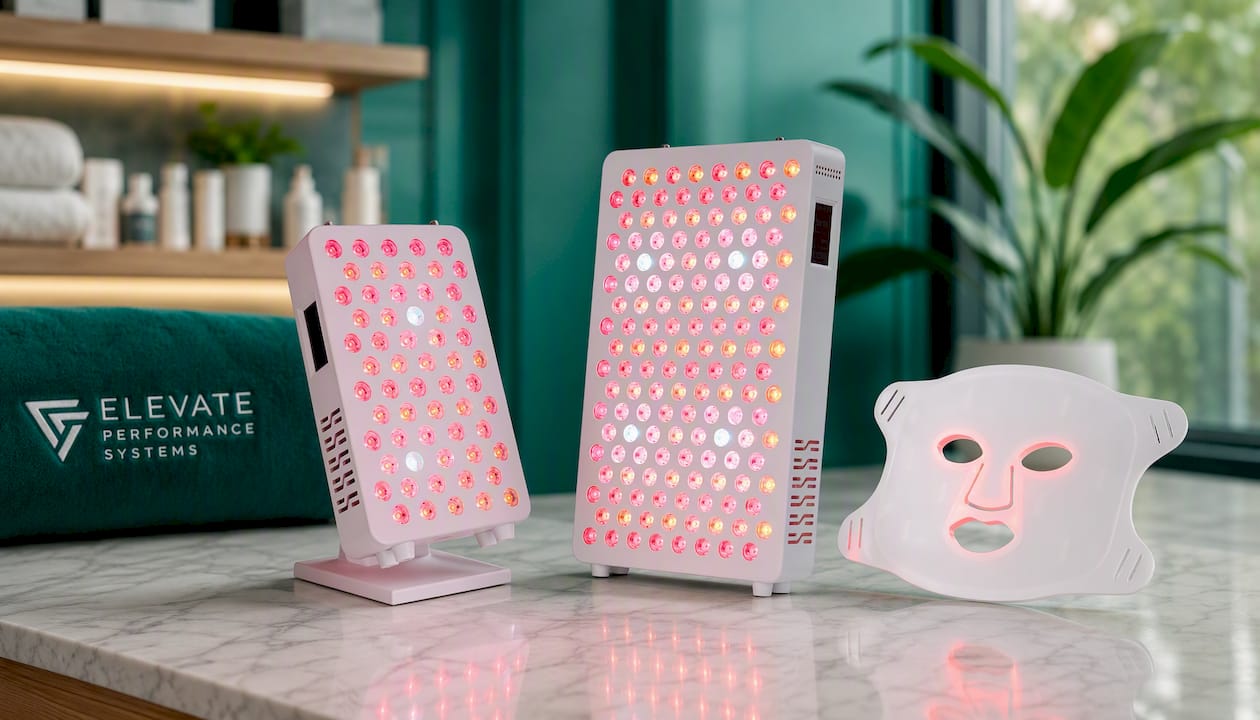
If your priority is targeted joint or small-area pain relief, the Compact Red Light Therapy Panel delivers focused irradiance without paying for coverage you won’t use. Athletes and anyone treating larger muscle groups for recovery should look at the Performance Red Light Therapy Panel, built for the higher area doses that hamstrings, quads, and shoulders require. For facial skin protocols, the Elevate Red Light Therapy Face Mask maintains consistent close-range exposure across curved contours that a flat panel can’t match.
Before you buy any device, run it against this checklist: confirmed irradiance at a stated distance, wavelength in the 630–670 nm or 810–850 nm range, and support you can actually reach if you have questions about your protocol. Browse the full collection of red light therapy devices to compare coverage areas side by side, and pick the one that matches the dose math for your specific goal.
Sources
For readers who want to go deeper, the umbrella review of photobiomodulation RCTs offers the broadest evidence summary across conditions, while the canonical PBM dosing table is the clearest reference for the 4 to 30 J/cm² therapeutic window. The PMC photobiomodulation review grounds skin-specific timelines in actual trial data, and the systematic review in Systematic Reviews is useful for understanding why protocols still vary so much across studies.
This article is general information, not a substitute for advice from a qualified doctor. Consult a qualified healthcare professional about your own circumstances before acting on anything here.
- Effects of photobiomodulation on multiple health outcomes: an umbrella review of randomized clinical trials
- Photobiomodulation review (PMC)
- Red Light Therapy Dosing Guide: How to Calculate J/cm² | LightTherapyIQ